April 26, 2009
March 30, 2009
Plans for the Future
What should I do while taking classes? I'm not positive. I have enough money to live at least through the summer without working, but if I can find a way to supplement my income I think it will be for the best. Finding another job as a software developer would be good, but I'd probably not have enough time to study if it was full time. My folks have a whole list of ideas from substitute teacher to administrator that they thing that I could get and would be good at. If they're sufficiently part-time, they could be good work. Personally, I'd like to pass myself off as a independent developer, and if I'm not planning on trying to live off the money I make, this might work. I'd also like to work more on my startup project, but that might have to take a backseat projects with more immediate promise. We'll see.
March 27, 2009
So I got laid off.
laid,
laid off. There is a difference.
So, anyway, IBM decided that I was too expensive to keep in my current position and decided to let me go. I'm not too worked up about this. It's not like I cared for IBM that much. They offered great services and benefits for their employees but they are also a little restrictive. I always felt like big brother was watching me, and long time IBMers seem to all have this forced enthusiasm that scares me.
I have a number of options. IBM gives me a 30 day grace period with which to look for a new job within the company before they severe my employment and wash their hands of me. which would be nice if it weren't that it was giving a couple thousand others the same grace period to apply to the same jobs. Apparently the odds are better if I'm willing to move to another country. There's also an outplacement service of which I intend to take full advantage.
More importantly, I think, is that this affords me an opportunity to shift gears a little. Up to this point I've been running on inertia. What I've always really wanted to do was found a company of some sort and be my own boss. Failing that, getting a degree, (eventually masters) in CS or similar always seemed like a worthy goal. When I got out of school, I was offered, almost by accident, an entry level position at IBM despite lack of any prior experience or training. The job had expansive benefits, flexible our, and plenty of pay for my needs so I thought I'd be a fool not to take it. I figured I'd say with the company for a year or six months and accrue some savings and experience before striking it out on my own.
Of course, then the depression hit and with so many of my friends out of work I felt that I should be thankful for having such a nice job. Almost felt guilty for anting to do something else. Also, given the economy, leaving just seemed like a bad idea. So, even though I strongly wanted to leave I didn't and just stuck with it because it was by far the easiest and safest option. I kept putting off my goals. And then I got laid off. So now I have no excuse. I wasn't a moment too soon.
So now I'm going to bill myself as a freelance software engineer or a startup guy. On that note, I kind of wish IBM had notified me a day or two sooner. I've been working on a project in my spare time and I had hoped to turn it into yet another dot-com idea. I even went so far as to apply to startup school. The application, though, was due the day before IBM let me go and I know I would have put more effort into it if I ad known I would be laid off soon. It's too bad, really, but in the grand scheme it's rather trivial.
So my course of action next? It's hard to say. I'll certainly apply for more jobs within the company, but I don't know that I even want them. I'll make sure that I take advantage of the time I still have my health insurance to get those health appointments that I've putting off. I've enough savings to live for a few months at least if I'm cheep so that's probably enough time to establish myself as an independent businessman if at all possible. Or I can find another company.
It seems the future's bright and getting brighter.
Labels: laid off
March 19, 2009
Exercise
I find that every time I take up an exercise routine, whether it be jogging, lifting, swimming, regular calisthenics, whatever, I end up quitting because I get bored. I usually start off strong, make progress in the first week or two and find that to keep up my rate of success, I have to increase the workout time until it just gets too boring to finish. It's not the physical exertion that gets me, its the time that I have to spend doing something that doesn't stimulate my mind. That's saying something because my mind isn't something to be proud of. Eventually, the exercise just seems like too much of a burden and after a few excuses every day, I just leave it off like I'd never started.
However, this time I've figured it out: Instead of focusing on improving, I focus on getting it out of the way. I run for a few blocks and stop, every weekday. I figure insufficient exercise is better than none. So, if I put in insufficient time into my workout, but consistently do it, I'm better off than I was before. It's working so far: I've been at it since December. Better yet, I've doubled me distance and kept it under the same time I was at the start. I do it every day and treat like a chore and now it's part of my routine, something I would notice if I quit.
So when folks tell you that laziness is a vice, or that you should turn your daily chores into fun things, you can cite this as a counterpoint.
March 17, 2009
Never mind the fact that the whole controversy is ridiculous as excommunication for abortion has been automatic for a very long time, what really got me was this quote:
The Vatican lives in a dream world where every child is a wanted child.Right, because only wanted children deserve to live. It's just like how only ones without down-syndrome and other genetic diseases deserve to live.
She goes on:
You naughty Catholics shouldn't be having sex unless you're planning to procreate!Well, yes. Duh. That would certainly solve this problem:
About five million women a year are hospitalized for complications due to unsafe abortions.The Catholic Church isn't living in a dream world; it just hasn't given up doing the right thing, like nearly the entire rest of society.
Labels: politics
March 7, 2009
Spring has Sprung
March 5, 2009
The Good Dr.
This Dr Thursday (It's not his real name just in case you could guess,) has a crazy amount of energy. Despite my being the younger party he seems to be the more youthful, which is something. I've never actually read any of Cardinal Newman before, but now I am and so far I'm quite impressed with what he has to say.
In conclusion, things are just beginning so there is no conclusion.
February 25, 2009
Funny Story
I get a lot of mail from my bank. It's mostly just paper reports telling how much I'd spent that week. They also send a number of ads and occasionally something important appears amongst the letters. Of course, seeing how most of the mail I get from my bank is useless to me, I tend to ignore it and put it in my "will get to it later" basket. It got so convenient throwing my mail into an easy basket, that I soon got used to throwing all my mail into the basket, save for the odd handwritten note. Needless to say important things can be missed this way.
So I picked up a giant pile of mail, put it on the floor, and began to page through it looking for the credit card that I knew must be in there. I eventually found the credit card, but not before making an interesting discovery. You, my Internet connection recently went out a few weeks ago and I've been trying to figure out what happened. None of the correspondence I sent attempting to figure out what had happen made it through, and thinking the provider, a local company, had simply flaked out on us, I was about to simply switch providers.
Well, I discovered a letter, dated from at least a month ago, informing me that the local company which had been providing Internet service, was now owned by the city, and that my bill for January was due a few weeks ago. I just now sent the payment. Go figure. Teach me to ignore my mail.
Oh, I also discovered a debit card.
January 30, 2009
January 8, 2009
on 'Injection'
I'm sorry, there seems to be a confusion. When I speak of 'spending,' I'm not worried so much about concrete public works projects, (which need to be judged on an individual basis,) but Keynsean 'injection.' The former is a problem, only when it finds it's justification in the later.
Public transportation (the 'tube' is a metro or subway right?) is a classic example of an industry which has a good argument for public maintenance. It is high investment with low returns, but clearly beneficial to the public.
Injection, however, is the process of increasing the demand in hopes of stimulating an increase in the supply. The problem is, that if there is no demand to begin with, then growth in this area is meaningless. For example giving subsidies to the Big 3 will help them produce more cars, but if nobody wants Big 3 cars, then we are waisting our time, and, depending on how the subsidies are raised, worse, potentially creating bigger problems.
The problem with spending like this is that the money must come from somewhere. The other problem with it is that it doesn't have to come from anywhere at all. I'll explain: All governments have two sources for funds (private institutions have analogues, but for simplicity's sake we'll ignore those,) taxes, and credit expansion. Taxes remove wealth from the economy, and, when spent, redeposit it elsewhere. Ignoring bureaucratic expense, this is a simple wealth transfer. It necessarily results in a loss of demand elsewhere. Unless the subsidized service is genuinely needed, (consumers just can't generate enough demand on there own to entice the supply to meet their needs, ie., they can't afford food,) this usually results in a net loss for consumers.
Credit expansion, or rather, inflationary spending, which today is fueled primarily by credit expansion, (they don't actually print the money anymore) is a different beast. Wealth isn't explicitly removed from the economy, but the signifiers of wealth, credit, whether it be actually currency or low interest loans (ie bonds, subprime mortages,) are introduced. In a perfectly responsive economy, the value of the money would instantly go down and the net effect would be the same as the tax option. In reality, it takes a while for people catch on to what is happening. The long term effect is still a wealth redistribution, but in the short term there is the illusion of greater wealth and a corresponding increase in spending and decrease in savings. This results in a transfer of investment from capital goods (factories) to consumer goods (Sponge Bob toys.) Part of this increase is a reduction in unemployment. The problem with this, is that it is temporary, and necessarily carries a backlash with it: when people realize that their wealth didn't actually increase, they'll find that they have spent more than could afford on goods that don't offer a return on investment. (Credit expansion, in my opinion, is one of the causes of consumerism and all it's evils, but that's not important here.)
The Keynsian system capitalizes on the temporary illusionment of people to create a system of slow credit expansion, not to grow industry, but to reduce unemployment and to increase the perceived quality of life. The way this works is that the government works with the banks (In America, this works through a combination of the Federal Reserve bond market, and secondary markets in Wallstreet and in real estate,) to create a small and steady rate of credit expansion, the idea being that the rate will be too small fro people to notice and for the economy to adapt. It was acknowledged even then that, this was unsustainable in the longterm, but this concern was dismissed. Keynes is famously quoted as saying, "We are all dead in the longterm."
When this was first attempted in the US, it worked for several decades. Employment dropped through the fifties and sixties, and increasingly monolithic and monopolistic corporations did well with the support of government funds. In the seventies, the market finally adjusted and there was a spike in unemployment and a recession. In order to fix the situation, an increase in spending was necessary. In addition to a few partial fixes to the system, Reagan introduced a a lot of new, inflationary, spending, which eclipsed previous spending. In combination with massive growth in Wallstreet, which began to should more of the responsibility in inflation (Tthe government isn't the only entity capable of inflationary spending,) the effect was eventually recovered.
So now you have a better picture of what I mean when I say that spending must increase. I don't mean that you just have to spend more wealth, which is possible in a growing economy, but that you have to spend a greater and greater percentage of the economy. You don't just keep inflating the money supply, you increase the rate at which you inflate the money supply, which, empirically, is unsustainable.
If it were possible for a government, or firm, to increase the amount of wealth provided to an economy your system would work. However, the government only redistributes wealth in this way, or borrows against the future. if we had some guarantee the fund would be invested wisely, this would be no problem. However, Keynsian injection, which is what is implied by the term 'stimulus,' nearly guarantees the opposite. Money is pushed into the economy at random and people, believing that they are richer than before and can afford it (not realizing that they are borrowing against the future,) buy a new television instead of insulating the house. Done on a grand scale over time, and you have a greater portion of the mess that wee are in now.
Labels: Economics, Free Market, injection, interest rates
December 22, 2008
Santa Claus
Labels: Santa Claus
December 2, 2008
Busking
The linked-to website is currently just a place holder, but the description should tell you what it's about. Essentially, the idea of cold asking for money on the Internet has always fascinated me. I know that it has worked spectacularly well in the past, albeit, intermittently. So, I felt I might create a project to help folks with it. Think: MySpace with a PayPal sticker, only more attractive. There seems to be a big demand, (and given the worsening economy, an increasing demand,) so I shouldn't have too much trouble getting it off the ground. I'm actively working on it and a proto-type should be up in a few weeks.
Up and coming: no guarantees.
Labels: busking, Internet, website, XCollegiates
September 30, 2008
Poetic

It seems that the banks which were supposed to safeguard our financial system are so confused about what constitutes a safe investment that they need to hire on new personnel. Why they are advertising through the local classifieds and not simply picking one of the hundreds of economists that would love to do the job is beyond me. However, it still seems that fate has a sense of humor.
September 26, 2008
Cold Weather.
I suppose that's the story of my life, really. Everything reminds me of something, but I can never remember what. I'm always thinking: "Ooh! This is like the time when... I don't remember."
It's weird the things I forget: words (I spent two minutes just now trying to remember 'nostalgic'), Christmas, birthdays of family, names of people I've just met and people I've known for years... At least once a week I forget the key to the office and I always kick myself for forgetting it.
I used to try to keep schedules, but I usually forgot to do them within a week. It's like a live in a perpetual present, knowledgeable of past and future, but unable to really connect with either.
Of course, I know what the really problem is. I don't get enough sleep. At least I think that's the problem, I can't really remember...
Anyway, this was supposed to about the nice autumn weather, which, in addition to being reminiscent of some forgotten, yet pleasantly melancholic memory, is also a very nice change from the constant, oppressive, cheeriness of the Summer. What's a little rain if it doesn't give you an excuse to relax inside and forget about all of your troubles.
Labels: Autumn, melancholic rants
September 12, 2008
XCollegiates
What it is is John, Sean and mine, new 'podcast.' It's really a blog with audio recording embed in the posts, but we'll fix that sooner or later, but for now, we're just getting started. We discuss everything from politics to philosophy to video games to film and of course we're always open to suggestions.
Check it out at XCollegiates.
Labels: blog, XCollegiates
August 14, 2008
Website
Check it out.
Labels: website
The Omnipotence Paradox (or: Why Hackers are like God)
There is a derivate of the argument, specific to particular interpretations of the omnipotent being, particularly those which insist on this being being omnibenevolent and omniscient in addition to being omnipotent. This argument generally goes like this:God is omnipotent (meaning that he can do anything.)
God therefore must be able to conjure an act which He is incapable.
quod erat demonstrandum:
God is not omnipotent.
Together, these two arguments make up the core of any argument against mainstream theism. Now, the first argument can be settled with a very obvious observation, that the ability to handicap oneself does not make one handicapped. And so, the notion that an omnipotent deity could handicap itself, does not make it any less omnipotent at this current moment. However, this observation fails to answer the second argument with any satisfaction and completely misses the core of the misunderstanding.God is omnibenevolent (and therefore wills the abolition of pain and suffering)
God is omnipotent and omniscient (and therefore can prevent all pain and suffering)
There is pain and suffering.
quod erat demonstrandum:
God is either not: omnibenevolent, omniscient, omnipotent or some combination thereof.
The core of this misunderstanding is pretty simple. Our words do not mean what we think they mean. Our problem , of course, is with the word 'omnipotent.' The colloquial understanding of the word is this:
That is, can do anything we can think of, regardless of any inherent contradiction, which in fact incorrect. The real meaning is more subtle. This is to be expected, seeing as the word is an import from Latin, A language which is usually more precise in modern times than English. Naturally, omnipotent comes from the Latin roots: 'Omni' and 'Potens,' meaning 'all' and 'power' respectively. When combined, they mean something akin to "power over all things." Thus omnipotence is a reference not to what the entity can do, per se, but what the entity has power over. Hence, a better understanding would go thus:Omnipotence:
- The ability to actualize any cognition.
This definition, while superficially sounding very much the same as the previous definition, actually suggests a much different relationship between omnipotent entity and the rest of reality. In the former definition, the deity acted more like an abstract will, arbitrating existence from a purely idealistic standpoint. The second definition, however, establishes omnipotence as, not some kind of innate property of the omnipotent, but as a relationship of the omnipotent to reality.Omnipotence:
-Absolute control over all of reality, in whole and in part.
----------
Up to this point, this argument has been exposited before, many times. (Hence the RSI.) One can check Wikipedia for a good discussion of the issue in great philosophical depth. Normally at this point in the explanation, one uses some kind of analogy, and I'm no exception. However, my analogy will be a little different. Instead of Lewis's wonderfully eccentric painter, I've got a megalomaniac hacker (in the positive sense of the word).
You'll see how this works: A computer is a tool for automation and abstraction. It contains a world unto its own in which arbitrary sequences of boolean values are assigned meanings. All kinds of meanings mind you: meanings such as '4,' 'addition,' and 'kill neighbor,' are all valid. By merely mapping values to an underlying set of instructions and formats designed to hold any kind of information imaginable, one can literally simulate any kind of world. Freed from the constraints of physical matter, computers can simulate all kinds of worlds possessed of any kind of laws and with any variables set. With respect to these worlds, the creator, (in this instance a hacker,) is omnipotent.
Let's look at this omnipotence. A hacker can create a world which mirror our own:
(setf 'one 1)
(setf 'two 2)
(setf 'three 3)
(setf 'four 4)
(setf 'five 5)
etc...So that the world's behavior mirrors our own:(+ 'two 'two) => 4Or he can create a world which is different:(setf 'one 5)
(setf 'two 4)
(setf 'three 3)
(setf 'four 2)
(setf 'five 1)
etc...And so create bizarre aberrations:(+ 'two 'two) => 8
(+ 'five 'four) => 3
etc...Or they can even change the rules at their most fundamental level:(defun + (&rest rest)
(reduce #'- rest))To remake reality in any arbitrary fashion desired:(+ 2 2) => 0Indeed, with the proper tools and knowhow, the hacker can even change the value of any variable, and redefine and function, at runtime. With respect to the little simulated computer people and their simulated computer world, he is god, and this is what we mean by omnipotent.There are some things, however, that our hacker cannot do. He cannot, for example, make the simulation run faster than a certain point due to physical limitations of the computer. This doesn't affect his omnipotence however; he still has absolute control over the nature of his simulated world, this a limitation of the world in which he it a part. His control still holds, but it seems that there is a sort of meta law to which his law must conform. The hacker may create a world that is subject to any rules he chooses, but he may not in doing so violate any laws to which he himself is subject.
We can thus apply this perception of omnipotence to a supposedly omnipotent entity: The great hacker who created the great simulation in which we are but objects. He controls the fabric of our universe, but cannot violate the fabric of his own. We thus see how omnipotence is not impossible, just over ambitiously defined.
But, we haven't really gained anything from this. We've removed one of the difficulties in approaching the concept of an omnipotent being, but at the same time, we've removed the chief advantage: that an omnipotent being provides a Occamian explanation for reality (this, in fact is very similar to the first application of his so called razor.) That is, it is easiest to explain all of reality as coming from a single principle, and this principle is most easily described as some sort of demiurge, which would necessarily be omnipotent in the manner described by this definition.
Fortunately, this problem is simple to escape. Even if we assumed the hacker had a magical computer which was freed of all physical limitations and he himself was freed all physical limits as well, there would still be limits on his actions. Those come not from any limits placed on the machine or scientist externally but those stemming from the scientist himself. Even if we were to pull out all of the stops, he would still be limited by his own imagination. In this hypothetical, the hacker could define function '+' such that it meant division, multiplication, addition, and subtraction all at the same time and in exactly the same context without distinction, except that that concept would be meaningless to him. He himself is unsure of what that would mean.
Does he mean?:
(defun + '((lambda (&rest rest) (reduce #'/ rest))
(lambda (&rest rest) (reduce #'* rest))
(lambda (&rest rest) (reduce #'+ rest))
(lambda (&rest rest) (reduce #'- rest))))Or does he mean?:(defun + (&rest rest) (reduce #'/ rest))
(defun + (&rest rest) (reduce #'* rest))
(defun + (&rest rest) (reduce #'+ rest))
(defun + (&rest rest) (reduce #'- rest))In fact, there is no way to express it because the scientist, being human, has no conception of what something to be multiple things at the same time without distinction would mean.In the same vein, an omnipotent demiurge is bound by its own nature. Anthropomorphizing it, it is bound by its goals, logic, thoughts, and imagination. If creating a simulation of a certain nature necessarily implies that that simulation posses a certain attribute which necessarily leads to a certain consequence, then the demiurge simply cannot both create that simulation and avoid that consequence. A hacker simply cannot create a process that both unceasingly conses and unceasingly accesses. It is not just physically impossible, but non-nonsensical.
And so, we come to the concept of 'god.' He is a hacker, living in a world where there is nothing but himself, and has chosen to create a simulation, (necessarily) of himself. This simulation, in order to be true to life, must include things like 'wills' and 'intellects,' and so, even though the great hacker in the sky is omnipotent, he must sacrifice a certain amount of control lest he contradict his own intent. To create a willful creature whose actions are predetermined is a contradiction. This concept, just like the '+' function mentioned earlier, has no meaning and our omnipotent hacker, like the any regular one, cannot do something which has no meaning.
Labels: God, omnipotence, philosophy
July 27, 2008
Tarmac
By 5:30 PM, it was time to leave, as my flight was scheduled for around 6:30, so the guys at the front desk rung up a cab for me. I realized as I was waiting that I was short on cash for the cab, and so went to the ATM, which wouldn't take my pin. I wasted ten minutes of my life trying to figure out if the machine was broken or my card. The cab arrived around 15 minutes later and the ride was rather restful except for the knowledge that I didn't have enough money for the ride. When I arrived at the airport I asked for a moment so the I could the airport ATM. After visiting every single corner of the airport except for the one with the ATM in it I finally found it, and found out that I couldn't find my card. Of course I went back to the cab to ask if the cabbie had seen it, which she hadn't. I rung up the hotel, but they didn't have it either. I knew that somebody was lying, but I couldn't tell who and was forced pay with my corporate amex. It was the amex's virgin run. I cancel my credit card and a new one will be shipped soon.
After all that, I still wasn't late for my flight, which had been delayed until 7:30 PM. It was then 6:30. I took my time and went through security. They threw away my soda but that didn't matter much. As I sat down, I realized that I was unbelievably anxious to get home. The minutes ticked by slowly and every minute the plain didn't arrive was really, really unpleasant. It finally did arrive around 7:15 and they let us board at 7:30 as promised. Everyone got on board quickly and things settled down, and just as the plain was making for the runway we were told we would have to wait. It had something to do with the weather. So, for about an hour and a half we watched as private jet after private jet took off. It was around 9:00, it was dark, and we were next on the runway to take off when we were told that there would be no more flights into DC because of the weather thereabouts. So I climbed out of the plain, went inside, and waited in line for about an hour as so that I could get information when I might yet be allowed to leave for home. It was of course next morning at 6:30 AM, a good twelve hours after I was supposed to leave in the first place. It was too long to wait in the airport, but too short a time to actually get a real night's sleep. It was also really late. Fortunately, some of the folks I'd chatted with in the ticket line were in the same bind as myself and were able to help in finding a hotel for the night, A place with a 5:30 shuttle to the airport. I paid for the stay with the amex and went to bed around midnight.
At 5:00 the next moring I got the wakeup call and showered, which was a good thing because I stank. What wasn't a good thing was that I didn't have any clean clothing. I hadn't expected the trip to last as long as it did and so, despite my shower, I still managed to smell. I was just in time for the 5:30 shuttle. Security, as I discovered, was much busier at 5:30 AM than at 5:30 PM, and I had a time getting through. However, the plain was on time, and managed to leave on time as well. Teh morning felt bright and clean after that and as I passed through my front door, I collapsed on the floor.
Then I recieved an email that my boss was wondering why I wasn't at work and wanted me in as soon as possible.
July 22, 2008
cult
The older, mean more senior, individuals seemed to take to it very naturally. They've either already been brainwashed or they've just become cynical enough to just play along. I can't decide which. I was hoping for some genuine information about how deal with the bureaucracy, how to enhance my prospects, and how to adapt to the corporate culture.
I found out about the last one all right. I'll be glad to get back into my little cube in a couple days. Doing actual work will be a nice change.
Update:
I've finished my second day of class now, and after a messy trip home (later post,) I'm still of the same opinion. I'm finding that being part of this larger corporation mean actually believing its propaganda and ad campaign. Lord knows that had to watch it. I think that the most alarming part is that it all felt like kindergarten. We've played games, stood in circles, voted with stickers, drawn with our left hand, all of which insulting our (or at least my,) intelligence. If people are dumb enough to seriously fall in with this, how do thy expect them to do the work that they are expected to do? I don't know. Maybe I just need to look into another job.
Labels: work
July 11, 2008
God is Class
This is all fine and dandy of course, except for one thing: nobody has any idea in Hell what it means. Which is too bad. However, for the narrow segment of humanity known as "Java Programmers," I have a solution. If the world were written in Java, God would be Class. That's right, God is the class Class. Not only that, but he is the static self instantiation of that class (a singleton class if you will.) Though, this doesn't quite get there. Being that Java is only a partially OOP language, God is also Object, and java.exe, but that's taking the analogy a little further than it needs to be taken.
Labels: God, Java, programming, religion
June 27, 2008
Another Wedding
Anyway, it was fun, and the first time I'd seen everyone since graduation. The afterparty was almost as much fun as the main event. Hopefully we'll see everyone again sometime soon.
Labels: wedding
May 14, 2008
It seems that I have graduated.
I had some fun mulling about afterwards saying goodbye to folks, and then when home. I think I spent about an hour pouring over my regrets, and then got over it. Which is a bit better than what happened when I gradated high-school. So College clearly wasn't a total waste. Maybe I got more out of it than just a little more stoicism, but I'll see it when I get to it.
Feeling a bit ill, and realizing why I don't usually drink, beer, I went to bed a bit early, and slept for a full twelve hours. Since then I've been busy about moving. It seems that life just keeps moving ahead. I think I've finally given up trying to slow it down.
Labels: graduation, School
May 5, 2008
Working at a Three Letter Firm
When we first started transitioning to the larger institution it seemed like it might a little 'fun.' We would have access to better equipment and billions of dollars of resources from some of the most advanced technological department around the world. This much proved true. My new Thinkpad T61p is top of the line and beats the hell out of that fie year old Dell POS I had been using previously. We also now get free downloads of advanced new software that would cost us thousands to purchase otherwise, a free on-line repository of technical books and direct contact via email to some of the most brilliant minds in the industry. It's really quite spectacular to work for a company that makes over three billion a year on patent claims.
However, there is a dark side and this dark side can be summed up in one word: "bureaucracy." That's right, this place is unbearably bureaucratic. I don't just mean that you have to wait in lines. I mean that EVERYTHING is bureaucratic, from HR to IT, even the software is bureaucratic. To give you an idea of how this works, I'll give you an example:
This firm, of course, suffers greatly from the 'not-invented-here' mentality. This, of course, I expected, licensing issues can be a problem and anyway, you have more control over that which you produce yourself. So, naturally, any non-internal solution (read software) that you want included in your project, must be approved by a central committee. This committee likes to take its time, no surprise. This is easy to deal with, just use as little external software as possible. This shouldn't be a problem, being a huge international firm, we have homegrown versions of everything. We rarely ever need to use the foreign version.
Unfortunately, there is a little snag. The homegrown versions don't work. Or they do, but they work poorly, or they just don't work in the want we want them to. Non of this is surprising, though perhaps it should be. Really, since the solutions don't work, all we have to do is submit bug reports and let the projects fix themselves. This is where it begins to get hairy.
Instead of a traditional bug reporting system, we, the this three letter firm, are required to fill out a PMR. Thats right, a paid maintenance request. Every sub organization in this firm is required to pay every other sub-organization for internal support. Again, this is not surprising, clearly it helps management and finance get a clearer picture of how resources are being allocated. What is the problem is the sheer number of steps required to submit this PMR. Let me recount them:
1. Naively send an email asking the other department for help in using their software after reading their intranet page which clearly requested that you email them for support.
2. Receive a curt reply three days later asking that you fill out a PMR anyway.
3. Research for two days in the company intranet how to do this.
4. Dial a number based on the information you find and find out that you need a special internal customer number. The guy on the phone gives you an address to request the number from.
5. Send a request for an internal customer number to the address given to you.
6. Receive a reply telling you that in fact, this was not the correct method for requesting a number. Instead, you are supposed to download a special application, which gives you a sheet to fill out with information about your line of business and sends itself to a guy in South America is isn't actually an employee of the three letter firm.
7. Spend two days downloading and installing the application and figuring out how it works and what information to input.
8. Accidentally send you're application to some guy in corporate who has absolutely no connection with your line of business.
9. Send the application to the correct guy and wait three days to approve your request and send you a number which you can use.
10. Fill out a request form for internal customer support.
11. I don't know, I haven't gotten this far yet. Step 10 was last week.
Seriously, it took me two weeks for me to get my department a number so that we could purchase internal support. Seriously, this is something that should have happened before transfer of trade ever occurred and should have been handled by individuals much further up the tree that myself. This is ridiculous. It should not be so complicated to just get basic work done. We've literally had to delay key features to later releases because of fiasco. With kind of inefficiency, it's amazing that they stay in business. I am seriously considering just dropping out and starting a competing firm based. With just three other guys, I could probably provide a more efficient service that this three letter firm. Or, maybe I'm just naive, or disgruntled, or something. Not that it really matters. I have a meeting with my boss today about my prospects here at the three letter firm. They had better be good.
Edit: I have since gotten through to the engineers on the other side. It seems that during the time I spent attempting to get through, the engineers managed to fix the problem. After about two minutes of back and forth with the tech, I managed to resolve the issue by simply downloading the latest build.
Labels: work
April 30, 2008
RSS for Dummies
Most of the websites which you visit have content that changes. Every blog, webcomic, newsite, photosharing site, Youtube variant, or MySpace clone that you visit as content which changes on a regular basis, and you visit each of these websites on a regular basis to keep up with that content. You visit each of them in sequence, waiting for them to load, to see if they have anything new. Sometimes they do, sometimes they don't. Sometimes your friend's blog has a new post, sometimes it doesn't, but you don't know until you've checked. You have to check every single site you patronize and if that's a lot of sites, you could spend a lot of time browsing the Internet, hours even. It can eat into you life. It's even worse if you have a slow connection and each page you visit takes a long time to load. It's simply not an efficient way to get things done.
What would be nice, is if you could have a program that would check each of your favorite websites for you, and tell if they've updated or not. Or, even better, download the changes for you so that you don't have to. Well, if something seems like it would be a good idea, chances are someone has already invented it, and this is no exception. RSS and Atom feeds are a very simple means of accomplishing this, and they are widely used.
The way RSS works is this: It is a little bit of code, usually saved in its own file on a website which specifies all of the websites's recent changes. It contains a list of the changes, plus, usually, the content of that change. Each of a newsite's recent articles are often listed in an RSS file and often the articles themselves are saved there as well. The website maintainer is responsible for keeping the RSS file, called a feed, up to date, but this is usually done for him with whatever program he uses to maintain the site.
A program, called an aggregator, can now check the website for updates, by simply looking for changes to the feed. If there are changes, it can then download them and notify the user. All that is needed to get it to do this is to be provided with the URL of the feed.
Most websites which use feeds have a little link or buttons on the front page which shows you this.
You simply right click on the button or link, select 'copy link,' and paste it into your aggregator.
In addition, some browsers, such as Mozilla Firefox, can tell if a website has a feed attached to it and it will tell you with an icon in the address bar:
Of course, in order to do this, you will need an aggregator. Fortunately, there are many options. The easiest is just to use an online service such as, Bloglines, Google Reader, Live.com, or Yahoo. You simply sign up, enter the feeds you want, and instead of having to visit multiple websites, now you will only need to visit one. The advantage of an online reader, is that is works no matter what machine you connect from, it will always be available. Also, it will update whle your computer is unpowered, so it will always be up to date, even if you've just turned on your machine.
There is also the option of using an aggregator installed on your own machine. popular aggregators include:
NewzCrawler - RSS News Feed Reader
FeedDemon - RSS News Feed Reader
Omea Reader - RSS News Feed Reader
You can also work is in with your browser with browser extensions.
Using an aggregator to read RSS feeds on can save you hours on the Internet. Considering that it only takes a few minutes to set one up, it is well worth your time to use one.
April 20, 2008
April 10, 2008
On Catholicism and Fascism.
This is a brief conversation I had recently on the YouTube:
Random crazy dude:
It doesn't matter if you went to these places. The fact of the matter is they jesuits have trained all of our top military officers, lawyers, judges and many rulers around the world. Like the king of Jordan, the president of the Philippines, Clinton was Jesuit trained and many CIA. that's just to name a few. You're either very dumb or you're purposely being deceptive.
Myself:
Bullshit. If you knew the first thing about Catholic or Jesuit ideology you would realize how stupid this is. The Supreme Court Justices, for the most part, are about as 'Catholic' as Voltaire.
Crazy Dude again:
I was raised Catholic. Beside that, the Justices are extremely catholic. Do a LITTLE research before you go around trying to say what's what. Why do you think torture is allowed? or the patriot act in effect which is very similar to hitler's enabling act? you're out of your mind. Fascism and catholicism go hand in hand. always has.
To be fair, I didn't really give him much of an argument. With the character limit and tiny print, it would seem that YouTube is designed to encourage unintelligent conversation. You could be a genius, but you'll sound like an idiot on YouTube.
HOWEVER, I couldn't just let this stand. It's too stupid, and stupidity is contagious. Especially on YouTube. So I'm going to go through each of his points and refute them one at a time:
Annoying is his claim that the Supreme Court is controlled by the Catholic Church. Ignoring the fact having Catholics on the court doesn't make it 'Controlled by the Church', (if it was mostly Jewish, would the court be 'controlled by the Zionists?'): Just because people claim they are Catholic doesn't make it so. In fact many so-called Catholics today are polluting the ground that they walk with with their absolute denial of Catholic social teaching. For example, take Chief Justice Roberts, who openly supports Roe vs. Wade and abortion rights despite longstanding condemnation by the Church: CA, Humanae Vitae, and even the document itself.
Then again, Roberts is a minor case. Justice Kennedy supports both abortion and gay rights, which, of course, are also against the teachings of the Church: ToB.
Clearly neither of these people are very strong Catholics if they can't seem to support basic Catholic social teachings. The Church has explicitly demanded an end to Abortion, Contraception, and Homosexuality, and places where Catholics are the majority seem to have movements that support this; take the Philippines for instance. But not in America. She seems to lack control over here. I'll ask you a simple question: How can an entity that is unable to do something as simple as get rid of abortion, something that a thin majority of American's actually want, be said to be secretly in control? I'll do you a favor and answer the questions: It can't.
I could go on all day about that but it's not even the weirdest claim. The notion that "many" leaders of the world being Catholic proves that their is some conspiracy is definitely weirder. There are a lot of Protestent Rulers as well, also secularists, Muslims, Buddhists, and many others. Are there secret undergrounds for these as well? I doubt it. It's not like he even sites interesting examples: King Abdullah of Jordan and Gloria Macapagal-Arroyo of the Philippines, like they have so much power or influence. The Jesuits may as well declare themselves in charge of Djibouti; it would do them as much good. More so actually, Jordan is the least powerful nation in the entire Middle East save Lebanon (which is by far more 'Catholic,' btw.) The reason he chose these countries, of course is that traditionally Catholics countries like Spain and Austria are no longer the shining examples of 'theocracy' they once were. The traditional powerhouses of the Church are now as secular as the rest of Europe which says something about the effectiveness of this Jesuit underground.
And there's the implication that Bill Clinton's time at Georgetown makes him 'Jesuit Trained,' (whatever that means,) completely ignoring the fact that Georgetown is the quintessential example of a once good Catholic university turned bad and anti-Catholic: check and check.
Seriously, the claim is goofy.
But the worst, of course, is the link to Fascism:
"Why do you think torture is allowed?" - Well it's not because the Pope approves of it.
"or the patriot act in effect which is very similar to hitler's enabling act?" - It probably has something to due with precedent. (Note the assumption that Catholicism had something to due with Hitler. Its funny considering that he forced a Concordat on the Church to prevent priests from being sent to gas chambers...)
"you're out of your mind." - This might be true... but its not because of my opinions of the Church.
"Fascism and catholicism go hand in hand. always has." - And that's it. Such a strange assertion considering Giovanni Gentile and Mussolini both explicitly rejected the role and the Church in public affairs and were both excommunicated. It's also odd considering that while the Church is a 2000 year old institution, Fascism was a short lived political fad of the 1920s and 30s that sought to supplant classical liberalism. It's also odd considering that the Hegelian philosophy of the Fascists explicitly contradicted several Church teachings by identifying the end of man with the state.
The fellow seems to think that because he was "raised Catholic," that it makes him knowledgeable about the faith, but I can assure you, thousands of 'Catholics' are raised every generation who know nothing about the faith. By nothing, I mean that they don't even know what the Eucharist is and they think that celibacy is a 'Sacrament.' So, his claims are pretty baseless.
Besides the whole concept of a global conspiracy is pretty cool. If I even had a hint of this thing I would be on board right away. I mean seriously.
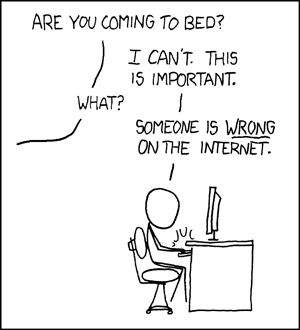
But enough of this. Arguing with someone on the Internet is a waste of time. As Randall Munroe would put it:

Labels: Catholicism, comspiracy, Fascism, Jesuits
April 1, 2008
Thesis
Labels: thesis
March 13, 2008
Subship pt. 2
In other news, I did finally begin writing my thesis. I'm not so sure what has taken me so long; it is probably my innate tendency to procrastinate. It seems like it might be easier than I thought, at least the first chapter will be. All I have to do is echo the same things OSS advocates have written about ad nauseam and add my own clarifications and qualifications. I hope to get it done in a reasonable amount of time.
Thank you and God Bless.
Labels: programming, sub, thesis
February 13, 2008
Voting
The sky was dark, the roads were icy, I had to get off of work early to take care of a few errands. The errands took longer than I thought, and when I was done, found that I needed a new tank of gasoline. As I pulled into the gas station and got out of my car, I realized that I was missing my credit card. I panicked and raced back to the house to get it. I turned over all the furniture, checked all my drawers, looked through all the pockets in my laundry only to find that it was in my wallet the whole time. I raced back to the gas station, braving the icy roads and heavy rains, carefully peering out of the window to see thing lane lines. I filled the tank as rapidly as possible and went off to look for the nearest polling place.
That's right, I went off to look for a polling place. I had no idea where one might be save that it was probably at one of the dozens of public schools in my area. I thought that it would probably be obvious. I was wrong. I drove around several blocks peering through the rain in vain and ended up at home at around six thirty, not having voted and having no idea what to do. The polls closed at seven.
I took to the internet and googled 'Manassas Park Polling Place,' and instantly a dozen entries popped up, all from two-thousand-six. I was disheartened. In a last ditch effort I looked up my email archives and discovered in a long lost mass email the secret: Go to the state website. Duh. In two minutes I had the location and was out the door. When I got there, there was a big sign telling voters where to park. I went in and it was nearly empty. There was no line. The people manning the election were friendly and in under a minute I had my 'My vote counted,' sticker on my windshield. I needn't tell you for whom I voted. (It was for Reagan.)
February 2, 2008
American Idol Sux
I don't watch the show, save rarely, primarily because I simply don't care for the kind of music it presents, so I really can't complain about the show itself. But what I hate is how it has became such a pervasive cultural presence. So much so, that otherwise respectable new sources will actually report on it. The show will air, someone will get voted off or something similar, and the news which comes on right after will report on it. As if I really needed to know. They could be reporting on the war, the election, the stock market, or something with even the slightest bearing on my life, but no, American Idol was more important.
Everything about the show is self aggrandizing. The theme music, the 'contestants', the judges, that queer host, everything, and the media treats it as if the self aggrandizement is to be believed. Its as if American Idol really were the greatest development in American culture, ever. Even it's title signals what I hate about it. It's that word 'Idol' juxtaposed with the word 'American.' As if this were what American's idolized: a bunch of vapid idiots belting out songs written by people far more talented. And the media eats it up. And the rest of the world thinks we're idiots. What a shame.
Labels: American Idol, things that suck
January 22, 2008
Against Ron Paul's supporters
What I am talking about is a zealousness that I believe is beginning to hurt the credibility of the campaign. While things like spamming internet polls and Digg, helped in the beginning to create an awareness of Dr. Paul, they increasingly give the impression of a sheep with a mob-mentality. This then gives people, including media people, an excuse to simply disregard the Ron Paul support altogether. Over dedication may cause us to lose everything.
To help provide a better understanding of what I am talking about, I will reference a certain event that happened a while back that was related to me by my brother who goes to West Point. West Point, as you should know, is one of the United States' military academies (Arm to be specific.) At the academies they encourage a certain group mentality as a rule and for good reason, any military that is not governed by individual egos is not likely to be very effective. On the battlefield, this group mentality is essential, and highly effective; in the civilian world however, it leads to a certain interesting consequences.
Among these is the incident that my brother related to me not long ago. Dave Matthew's band had placed an offer that members of any college or university could vote on the band's website for their own college as the location for the band's next performance. The idea behind this, of course, was to appeal to the greatest number of fans. Now, not every cadet is a fan of Dave Matthews band, but at least a few firsties are, and they determined that West Point would be the place for Dave Matthew's band to perform. They voted and pressured their peers into voting as well. Very soon it became clear that this was a competition the West Point was involved in and it became a question of loyalty amongst the cadets vote in the competition. When Annapolis got involved in the same thing, any one who didn't vote risked getting hazed. As a result, nearly every cadet at West Point voted, some twice, to get a band for which not all of them cared.
The contest ended with West Point in the lead, followed closely by Annapolis and the Air Force Academy. Civilian colleges followed these by a significantly wider margin. When the band actually showed up, the turnout was actually quite a bit smaller than the vote count would have lead one to believe. Whereas at civilian colleges, only actual fans of the band voted, at West Point, everyone voted whether they liked the band or not, and this inflated the actual support for the band represented in the vote.
Needless to say, this certainly hurt civilian fans' of the Dave Matthews Band opinion of West Point. Many of them grumbled and complained and at least one of them made the mistake of saying something he really shouldn't have. He unfortunately caught the attention of the cadets and it quickly became a question of loyalty to email him and tell him what they thought of him. Some cadets figured out his contact information and quickly spread it around. Now, there are around 4,000 undergraduates at West Point, most of whom sent this fellow two or three emails. Many of them also called him or sent him conventional letters. This amounts quite a lot of hate mail. I have assurances from my brother that this is quite typical of how the cadets conduct business.
Now don't get me wrong, this is a good mentality for a military to have. It makes for a stronger and more functional fighting force, but you don't have to be a sociologist to determine that it leads to some very significant PR issues in the civilian quarter. Personally I think that sacrificing a few concerts is a small price to pay for a strong national defense. However, when applied to a political campaign, this kind of PR problem means the world.
When ABC, or NBC, or CBS, or whatever news group places a poll on their website, they are looking for the opinion of the regular followers of the website. Regular users tend to vote and leave. A good number of Ron Paul supporters however, vote, and then email all their friends, notify everyone in their Meetup groups, contact known supporters on Facebook, until just about every supporter of Ron Paul has had a chance to vote in the poll. The result is inflated results that the newsgroup just disregards. What's worse is when the Ron Paul supporters vote in his favor even when the situation does not warrant it; for example: voting him the clearest speaker at a debate when speaking is clearly his greatest weakness (I get the impression that he is trying too hard to express too much at once, and is thus succeeding in communicating less overall.) It's similar with Digg, where articles that even briefly mention Dr. Paul in a positive light get boosted to the top. As one anonymous forum goer once said, "I despise Ron Paul and his army of diggers." Clearly these tactics are winning detractors, not supporters.
Other problems occur when supporters pounce too quickly on objectors in forums and message boards and as a result, instead of winning over a convert, as they could if they were more judicious with their comments, they instead earn an enemy who will now likely vote for Romney or McCain just to spite them. This is hurting the cause.
In short, while I see signs of promise, libertarianism, constitutionalism, traditional liberalism are on the rise and and people are starting to see through the empty promises of statism, this particular expression of that is not going to help, either in the short or in the long run. Ron Paul supporters, chill out, before you screw things up for everyone.
Labels: brother, group mentality, Ron Paul, West Point